
Who Decides Who You Don't See?
Published by © 2026 Nevada Motojicho. All rights reserved. in Nudist/Naturist · Thursday 10 Sep 2026 · 8:00
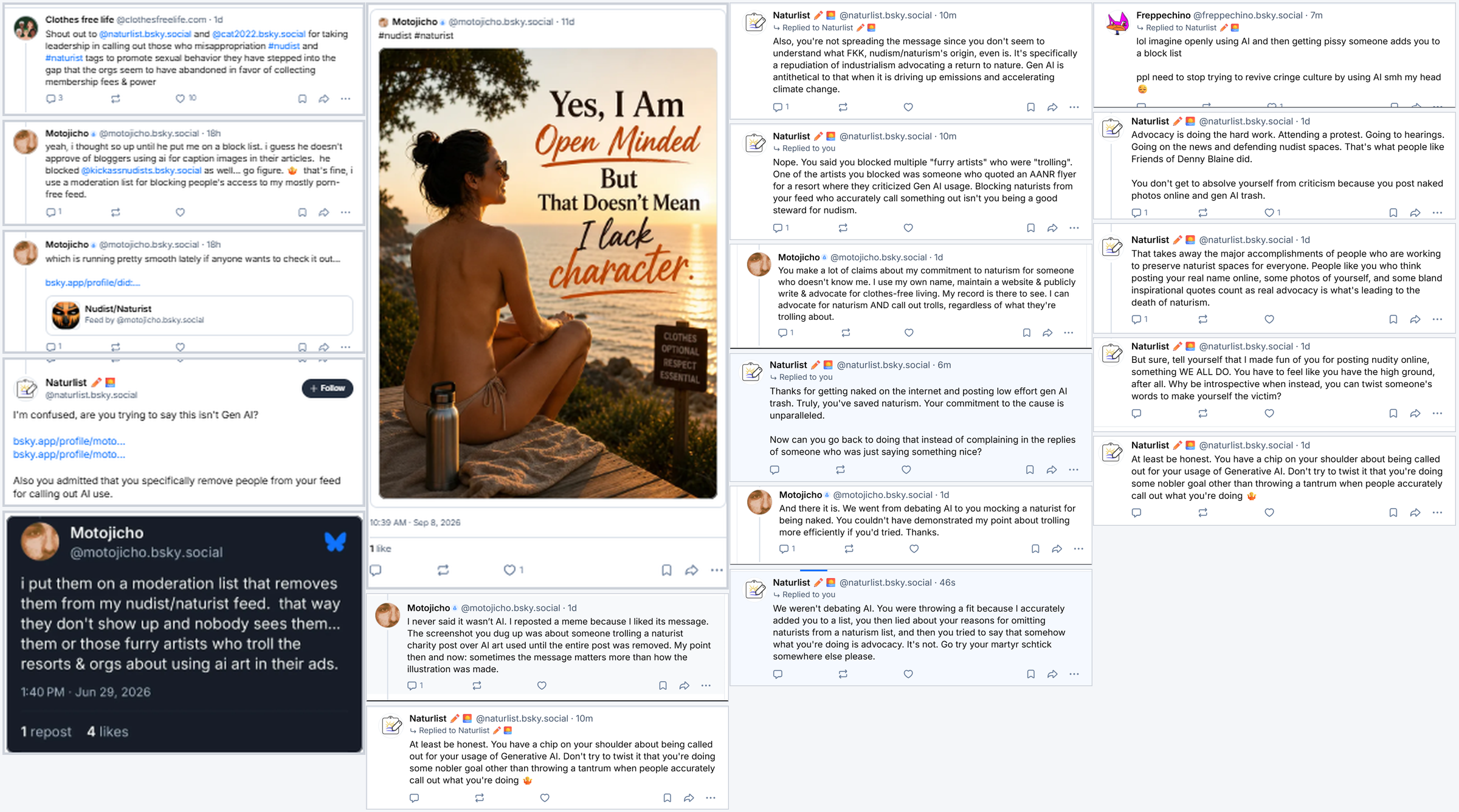
(If you wish to read actual conversation thread, click the image to enlarge)
Who Decides Who You Don't See?
 or
 Feed
I have two kinds of block lists on Bluesky, and until recently I hadn't given much thought to why I keep them separate.
My personal block list is small. It's mostly people I don't particularly like, which seems as good a reason as any not to invite them into my social-media life. I don't need a committee, a policy statement, or evidence of wrongdoing. Sometimes you simply decide you've heard enough from someone and close the door.
My moderation lists are different. I use those primarily to keep pornography and other objectionable material from appearing in naturist feeds where other people may encounter it. Those lists aren't really about whether I like someone. They're about what I'm willing to put in front of the people who choose to follow a feed I've created.
That distinction matters on Bluesky because personally blocking someone doesn't necessarily solve the second problem. Someone I've blocked can still turn up in a feed and contribute or share things there, even though I may not see what they're doing because I've already blocked them personally. In a strange way, blocking someone can make me less aware of what other people using the feed may be seeing.
So I moderate the feed separately.
That all seemed fairly straightforward until I discovered that I had landed on somebody else's moderation block list.
My offense was apparently using artificial intelligence.
I sometimes use AI-generated artwork to illustrate things I write. I think of it much the way I think of a magazine illustration or a bit of layout artwork. The image accompanies the writing. It isn't pretending to be the writing, and I've never been particularly secretive about how those images are made. I clearly source list it as ai generated on the article page.
Recently I reposted an AI-generated naturist meme because I liked the message: being open-minded doesn't mean lacking character. I liked what it said, so I shared it.
That led to an exchange with another naturist account that strongly objects to AI artwork. The disagreement itself didn't particularly bother me. People disagree about AI every day, and I suspect we'll continue doing so long after we've found something newer to disagree about.
What caught my attention was discovering that my use of AI had apparently become a reason for putting me on a moderation block list that people can subscribe to.
Now that interested me.
If someone doesn't like AI and therefore doesn't want to see anything I post, the solution seems remarkably simple: block me. I do essentially the same thing myself. That's what a personal block is for.
But putting someone on a moderation block list is different, particularly when other people subscribe to that list.
Now the decision travels.
Someone who has never encountered me may never see something I've written because another person decided my use of an illustration was sufficient reason to remove me from view. They don't know whether I'm a spammer, a bot, a porn account, a troll, or simply a naturist who uses a tool the curator dislikes.
They only know (or don't know) I'm gone.
And that made me wonder what exactly we're trusting when we subscribe to somebody else's moderation list.
The obvious answer is judgement.
Sometimes that's precisely what we want. I don't need to personally inspect every account posting pornography into a naturist feed before deciding whether I'd like someone else to help keep it out. Good moderation saves time, keeps feeds usable, and prevents people from being subjected to material they didn't sign up to see.
But there's an enormous difference between trusting someone's judgement about behavior and unknowingly inheriting their judgement about people.
That difference became clearer as the conversation about AI continued. Before long, we weren't really talking about AI anymore. We were talking about what counts as naturist advocacy.
Apparently writing about clothes-free living wasn't enough. Maintaining a website wasn't enough. Posting publicly under my real name wasn't enough. Sharing nude photographs wasn't enough. Advocacy, I was told, meant things such as attending protests, going to hearings and publicly defending nudist spaces.
Those are certainly forms of advocacy. Important ones.
They're just not the only ones.
I've never believed every naturist has to contribute to naturism in the same way. Some organize events. Some serve on boards. Some fight legal battles. Some maintain beaches and clubs. Some write. Some take photographs. Some quietly introduce a nervous newcomer to social nudity and never receive so much as a thank-you note for it.
Some simply live openly enough that somebody else realizes being a naturist isn't quite as strange as they thought.
I don't know when we decided there had to be an entrance exam.
Yet social media makes it remarkably easy to create one. Disagreement becomes a standard. The standard becomes a list. Then other people subscribe to the list, and a personal opinion quietly becomes somebody else's filter.
That's the part I find more troubling than being on one.
During International Skinny Dip Day, I watched another version of this happen. A naturist organization was promoting an event that was also raising money for charity. Some artists objected strongly to the organization's use of AI artwork and repeatedly attacked it over the illustration.
Eventually the organization removed the entire post.
The AI artwork disappeared.
So did the charity appeal attached to it.
Whatever anyone thought about the illustration, hundreds of people who might have seen an opportunity to contribute to a worthwhile cause no longer saw it. The battle over the method had become more important than the message it was carrying.
That experience was why I had little patience when the same argument surfaced again.
AI will change. The tools will improve, companies will come and go, the current enthusiasm may cool, and people will continue arguing about what any of it means. I'm not especially interested in turning The Turtle's Diary into a defense of artificial intelligence.
I'm much more interested in what we do to one another because of it.
The recent exchange eventually reached the point where I was thanked sarcastically for "getting naked on the internet" and posting AI trash. That struck me as a peculiar place for a naturist disagreement to arrive.
We had begun with an objection to artificial intelligence and somehow ended with one naturist mocking another for being naked.
At that point, I stopped responding.
But the moderation list stayed in my head.
Not because I'm particularly wounded by being on it. I survived the discovery remarkably well. I made coffee the following morning, the sun came up, and civilization continued with surprisingly little disruption.
What stayed with me was the person who subscribes to that list without knowing any of this happened.
They may believe they've subscribed to something that protects them from spam, trolls, pornography or genuinely disruptive accounts. Maybe most of the list does exactly that.
But perhaps mixed among those accounts are people who simply disagreed with the curator.
How would the subscriber know?
That's the uncomfortable bargain hidden inside shared moderation. We're not merely borrowing somebody else's list. We're borrowing their judgement, including the parts of that judgement we may never see.
That doesn't make moderation lists bad. I use them. I need them. Without moderation, a naturist feed can become something entirely different from what its followers expected remarkably quickly.
It does mean I want to know what kind of list I'm trusting.
Is this a list of accounts posting pornography?
Is it spambots?
Harassment?
Or does it also contain people the curator dislikes, people who use the wrong tools, belong to the wrong organization, use the wrong terminology, practice naturism differently, or failed somebody's private definition of what a proper naturist ought to be?
Those aren't the same things.
Naturism asks something unusual of the world around us. We ask people to look beyond an immediate reaction to nudity and consider the person instead. We ask them not to assume that seeing a naked body tells them everything they need to know about whoever is standing in it.
It seems worth extending the same courtesy to one another.
Moderate the porn. Remove the spam. Block the troll. And if somebody drives you absolutely crazy, by all means use that personal block button. I certainly do.
But if we're going to decide who everyone else shouldn't see, I think the standard ought to be a little higher than I don't like the way that person does naturism.
Otherwise we aren't protecting the community.
We're just making it smaller.
(If you wish to read actual conversation thread above, click the image to enlarge)
* The Turtle’s Diary is a collection of thoughts, insights, and stories based on true-life experiences – all born from the misguided trust in others.
or Feed
There are no reviews yet.
Your opinion is important to us and helps us improve our service.