When Did We Decide That This Tool Was Different?
MotoBlog
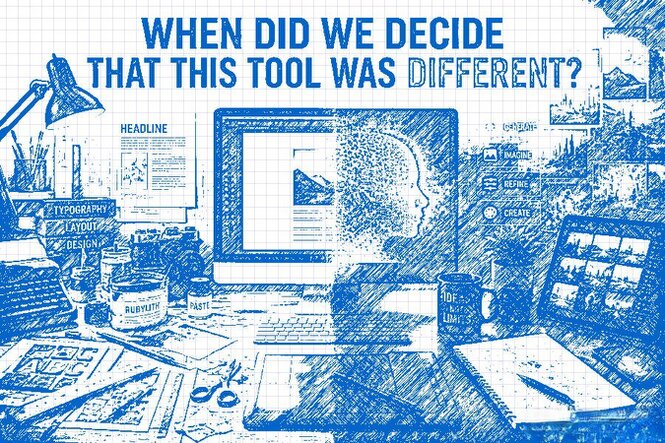
(Image created by Motojicho using Adobe Illustrator, Photoshop, and other tools within the Adobe Creative Suite)
When Did We Decide That This Tool Was Different?
Every so often I'll come across a graphic artist posting an image online explaining why artificial intelligence is destroying creativity, stealing jobs, ruining the environment, or producing work that isn't "real art."
The comments are usually predictable. Some agree enthusiastically. Others defend AI just as passionately. Before long, the discussion has very little to do with artwork at all. It becomes another argument about technology, ethics, and the future.
I've watched these debates with genuine interest because I've spent much of my adult life watching computers change the way creative people work. Long before AI entered the conversation, I watched desktop publishing transform newsletters, annual reports, magazines, brochures, and eventually websites. Every new generation of software promised to make design easier, faster, and more accessible.
When I first became involved with desktop publishing, "cut and paste" wasn't a command hidden under an Edit menu. It involved X-Acto knives, beeswax, camera-ready boards, Rubylith, and more patience than most people today can imagine. If a headline wasn't straight, you peeled it off and tried again. If a layout changed, so did half your afternoon. There wasn't a button to undo your mistake. There was only the opportunity to do it over.
Then desktop publishing arrived.
I remember building newsletters in Ventura Publisher back when Xerox owned it. Later came CorelDRAW, Paint Shop Pro, Photoshop, Adobe Creative Suite, web editors, page layout software, and more graphics applications than I can remember. Every few years another program promised to make some part of the creative process easier, faster, or more powerful.
And every few years it did.
Looking back, that's what strikes me as odd about today's debate.
Many of the strongest objections to AI are coming from professions that have spent decades embracing technological shortcuts.
I don't use the word "shortcut" as an insult. Every tool is a shortcut. A paintbrush is a shortcut compared to finger painting. A camera is a shortcut compared to painting portraits. Desktop publishing was a shortcut compared to setting movable type by hand. Digital photography replaced darkrooms for most photographers. Photoshop eliminated techniques that once required hours of painstaking manual work. Spellcheck replaced the dictionary that used to sit beside the typewriter.
Nobody seriously argues that we should return to those older methods because each new tool allowed us to spend less time on repetitive tasks and more time making creative decisions.
Graphic artists have done exactly the same thing.
One of the most common criticisms I hear today is that AI-generated artwork all looks the same. Perhaps that's true in many cases. But I also remember when desktop publishing became object-oriented and drag-and-drop. Suddenly everyone had access to the same templates, the same font libraries, the same clip art, the same layout guides, and eventually the same stock photography. Before long, newsletters began resembling other newsletters, magazines borrowed the same visual language, and websites often became remarkably similar.
Nobody called it "template slop." They called it progress.
Looking back, I don't think the software was really the reason everything looked alike. Most people simply used the tools exactly as they came out of the box. Early desktop publishing had a recognizable look. Early websites had a recognizable look. Early PowerPoint presentations had a recognizable look. Even Photoshop developed a recognizable look as people discovered the same filters, bevels, gradients, and effects at roughly the same time.
That wasn't a failure of the software.
It was the predictable result of millions of people using the same new tools in much the same way.
Over time, talented designers pushed beyond the defaults. They stopped relying on templates and began using the software as a creative instrument rather than a collection of presets. The tools didn't become more creative. The people using them did.
I sometimes wonder if AI is simply passing through that same stage. Much of what we see today comes from people asking the same tool to solve the same problems with remarkably similar prompts. It shouldn't surprise us that much of the output resembles the work sitting next to it. We've seen that pattern before.
Perhaps that's why I've never been particularly bothered by the argument that computers somehow diminish creativity. I've spent decades watching software evolve from little more than a digital drafting table into a remarkably sophisticated creative partner. Along the way, I've used everything from desktop publishing programs to Adobe Creative Suite, taking vector illustrations apart piece by piece, altering individual elements, and rebuilding them into something entirely different. None of those tools replaced my creativity. They expanded what I was capable of creating.
That's what makes AI feel different. For the first time, the software isn't simply carrying out instructions more efficiently. It's beginning to contribute possibilities of its own.
Which makes me wonder why this particular tool suddenly feels so different. I suspect the answer is that AI doesn't merely automate production. It participates in creation.
That feels different because, for the first time, the computer isn't simply carrying out instructions. It's generating possibilities we might never have considered ourselves. Whether those possibilities are brilliant or terrible is almost beside the point. The relationship between artist and tool has changed, and that understandably makes people uncomfortable.
History suggests we've been here before.
Photography was once criticized for threatening painters. Digital cameras threatened film photographers. Desktop publishing threatened typesetters. Word processors threatened professional typists. Computer animation threatened traditional animation.
Every generation eventually draws a line and declares, "Everything before this point was a tool. Everything after it is cheating."
The interesting thing about those lines is how rarely they stay where we first draw them.
I'm old enough to remember when using a computer for graphic design was considered taking the easy way out. There were artists who insisted that real creativity happened with pencils, brushes, drafting tables, and darkrooms. Today, many of those same digital tools are considered indispensable. Nobody thinks twice about using Photoshop to remove a telephone pole from a landscape photograph or Illustrator to perfectly align a logo. Those innovations stopped being controversial years ago because they quietly became normal.
Perhaps AI will follow the same path. Perhaps it won't. I honestly don't know.
None of this means AI deserves a free pass. Questions about copyright, attribution, consent, environmental costs, authenticity, and economic impact are real questions, and they deserve thoughtful discussion rather than slogans shouted from either side of the debate.
What gives me pause is how quickly we assume this moment is unlike every technological transition that came before it. History has a habit of humbling that kind of certainty.
Creative people have always adopted better tools. Sometimes reluctantly. Sometimes enthusiastically. Almost always while insisting that this latest innovation was fundamentally different from every one that came before it.
Sometimes they were right. More often, they were simply standing where history happened to place them. Perhaps that's why I can't bring myself to declare AI either the salvation or the destruction of creativity.
History rarely remembers the arguments about the tool.
It remembers what people eventually created with it.
 or
or  Feed
FeedThere are no reviews yet.
Your opinion is important to us and helps us improve our service.